

West vs East Nusa Penida Day Tour
Choosing between a West vs East Nusa Penida Day Tour can completely change your experience on the island tours. Nusa Penida is famous for dramatic cliffs, turquoise water, hidden beaches, natural rock formations, and spectacular viewpoints, but its attractions are spread across a surprisingly large area. Because most travelers have only one day, deciding which side to explore before arriving can save hours of driving and make the trip much more enjoyable.
The western and eastern sides each have a distinct character. West Nusa Penida is generally associated with iconic viewpoints and internationally recognized landscapes, while the east is known for spectacular beaches, elevated coastal scenery, and a slightly different atmosphere.
There is no universal answer to which side is better. The right choice depends on what you want from your day.
West Nusa Penida: The Iconic Side
For first-time visitors, the western side is often the most obvious choice.
This area contains several attractions that have become symbols of Nusa Penida day tour itself. Kelingking Beach is probably the best-known example, with its distinctive cliff resembling a dinosaur overlooking the Indian Ocean.
The western route also includes Broken Beach, Angel’s Billabong, and Crystal Bay, making it possible to experience several different types of scenery without crossing the entire island.
That variety is one of the biggest advantages of choosing the west.
You can spend the morning looking over enormous limestone cliffs, walk around unusual coastal formations, stop for lunch, and finish the day near a beach or snorkeling area.
For travelers visiting Nusa Penida for the first time, this combination can provide an excellent introduction to the island.
Kelingking Beach and Its Famous Cliff
Kelingking is usually the biggest attraction on a western itinerary.
The viewpoint sits high above the ocean and offers a spectacular view of the T-shaped or dinosaur-like peninsula below. From the main viewing area, the contrast between green vegetation, pale cliffs, and deep blue water creates an unforgettable landscape.
The famous beach below is accessible by a steep trail, but descending all the way to the shoreline is not necessary for a day tour.
In fact, attempting the hike can dramatically change your schedule.
The trail is physically demanding and can take considerably longer than expected, particularly when temperatures are high. Visitors who want to see several western attractions may prefer to remain at the viewpoint.
This is also a good example of why an itinerary should be based on priorities rather than trying to experience every attraction in depth.
Broken Beach and Angel’s Billabong
Two other western attractions that work naturally together are Broken Beach and Angel’s Billabong.
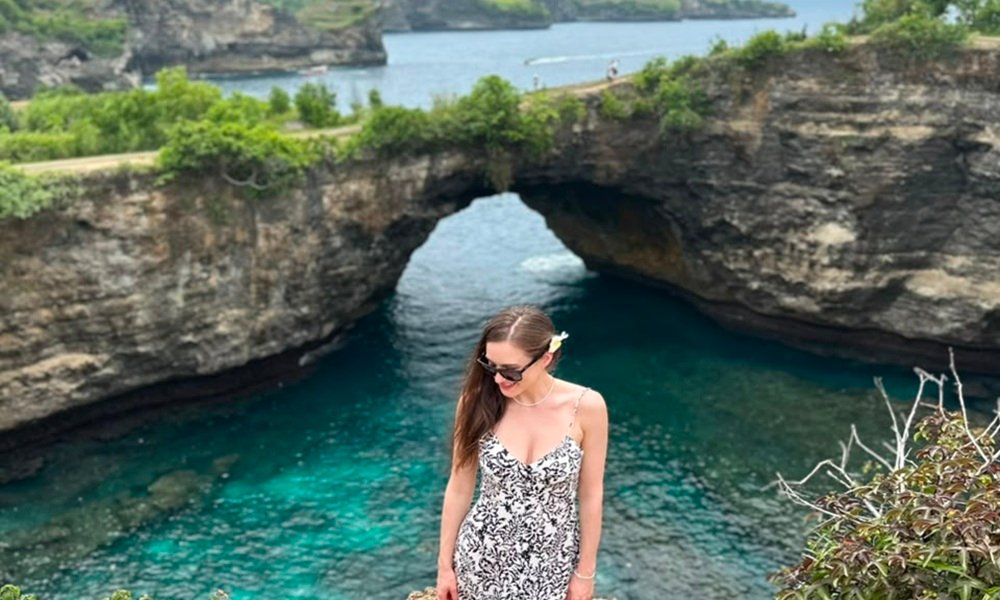
Broken Beach, locally called Pasih Uug, is famous for a massive natural arch carved into the limestone coastline.
From above, the circular formation creates an unusual lagoon-like appearance, with ocean water entering through the arch.
Nearby Angel’s Billabong offers another perspective on the island’s geological character.
Its natural rock pool sits beside the ocean and can look particularly beautiful when water conditions are calm.
However, visitors should be cautious around both locations. Coastal conditions can change quickly, and natural pools are not automatically safe for swimming.
The safest approach is to follow local instructions and avoid entering the water when waves are strong.
Crystal Bay
Crystal Bay gives the western route a different atmosphere.
Instead of focusing entirely on cliffs, this area provides a beach environment surrounded by hills.
It is also associated with snorkeling and marine activities. Depending on the season and sea conditions, visitors may encounter interesting marine life in the surrounding waters.
However, wildlife sightings are never guaranteed.
If snorkeling is one of your main goals, it is better to organize your day around the water rather than treating snorkeling as a quick addition between several land attractions.
A dedicated snorkeling itinerary allows more time for boat travel and exploring different underwater locations.
Why Choose the West?
The western side makes sense if your priorities include:
- Famous Nusa Penida viewpoints
- Dramatic cliffs
- Photography
- Kelingking Beach
- Broken Beach
- Angel’s Billabong
- A first introduction to the island
- A mixture of landscapes
It is particularly attractive to travelers who want the classic Nusa Penida day tour experience.
If you have seen photographs of Nusa Penida on social media and immediately recognized the dramatic dinosaur-shaped cliff, there is a good chance you are already interested in the western route.
East Nusa Penida: Beaches and Coastal Views
The eastern side offers a different experience.
Instead of concentrating on the most internationally famous cliff formations, the east is particularly appealing for travelers interested in beaches, viewpoints, and dramatic coastal landscapes.
Diamond Beach is the standout attraction.
The beach sits below towering cliffs, with bright white sand and striking turquoise water. From the viewpoint above, a staircase descends toward the shoreline, creating a spectacular perspective over the coastline.
Atuh Beach is another major attraction in the east.
Its curved coastline and surrounding rock formations give it a more traditional tropical beach appearance than some of the rugged western viewpoints.
The eastern route is therefore especially attractive to travelers who want more beach scenery during their day.
Diamond Beach
Diamond Beach is one of the strongest reasons to choose the eastern side.
The viewpoint above the beach provides a sweeping panorama of the coastline. A distinctive rock formation offshore adds to the dramatic appearance.
The staircase leading downward can be steep, so travelers should consider their physical condition before attempting the descent.
You do not need to reach the bottom to appreciate the scenery.
For many visitors, the elevated viewpoint is actually one of the highlights because it provides a broader view of the beach and surrounding cliffs.
If you do descend, allow enough time to climb back up. The tropical heat can make the return journey more challenging than expected.
Atuh Beach
Atuh Beach provides a completely different mood.
Its sheltered setting, curved shoreline, and surrounding cliffs create an inviting tropical landscape.
Travelers who prefer spending time near the water rather than standing at cliff viewpoints may find Atuh Beach more satisfying.
You can relax, take photographs, or simply enjoy the scenery.
The beach is also a good reminder that the eastern side should not be treated as merely an alternative to the west. It has its own identity and deserves to be considered independently.
Thousand Islands Viewpoint
The Thousand Islands area provides another spectacular elevated perspective.
From the viewpoint, you can see multiple rocky formations scattered across the sea.
The landscape is particularly impressive from above, with cliffs and islands creating layers across the horizon.
A famous treehouse nearby has also become a popular photographic location.
The combination of viewpoints and beaches means an eastern itinerary can offer considerable visual variety even though the overall atmosphere differs from the west.
West vs East Nusa Penida Day Tour: Which Has Better Beaches?
If beaches are your main priority, the east generally has the advantage.
Diamond Beach and Atuh Beach are major reasons travelers choose this side.
The west has beaches too, but its strongest attractions are arguably its cliffs and geological formations.
Therefore, someone who wants to spend more time looking at dramatic coastal scenery may prefer the west, while someone who wants to combine viewpoints with beach time may enjoy the east.
Neither side is objectively better.
It is about matching the destination to your interests.
Which Side Is Better for Photography?
This depends on the type of photographs you want.
The west is excellent for dramatic landscape photography.
Kelingking offers a recognizable composition that immediately communicates “Nusa Penida.” Broken Beach and Angel’s Billabong provide unusual geological formations, while Crystal Bay adds beach and ocean scenery.
The east is especially strong for elevated beach photography.
Diamond Beach provides spectacular views from above, while Atuh Beach offers a more traditional tropical composition.
For social media photography, both sides offer plenty of opportunities.
If your goal is to capture the most recognizable Nusa Penida landscape, the west probably has the advantage.
If you want a broader collection of beach photographs, the east may be more suitable.
Which Side Is Better for Families?
Families should consider walking distances, heat, stairs, and road conditions rather than simply choosing attractions based on popularity.
The west can involve considerable walking around cliff viewpoints, while the east includes steep stairways at some beaches.
Parents traveling with young children may prefer a private vehicle and a relaxed itinerary with fewer stops.
Trying to visit too many destinations can make the day tiring for everyone.
A family-friendly trip should allow time for food, water, rest, and shade.
The best itinerary is not necessarily the one with the greatest number of photographs.
Can You Visit Both Sides in One Day?
Technically, you can attempt it.
Practically, I would not recommend it for most travelers.
Nusa Penida’s roads and distances make cross-island travel slower than the map may suggest. Traffic, narrow roads, tourist vehicles, and stops at popular attractions can quickly consume your available time.
A day trip is much more enjoyable when you concentrate on one geographical area.
If you have two days, however, splitting the island is an excellent option.
You could dedicate one day to the west and another to the east.
That approach gives you considerably more freedom.
West or East for First-Time Visitors?
For a first visit, the west is often the safer choice if you want to see the island’s most recognizable attractions.
Kelingking, Broken Beach, and Angel’s Billabong provide a strong introduction to the dramatic character of Nusa Penida.
But there is an important exception.
If you have already seen Kelingking in photographs and are more interested in beaches, the east could be the better choice even on your first visit.
Travel should be based on what you personally want to experience rather than what is most popular online.
How Early Should You Start?
An early start is valuable regardless of which side you choose.
Most visitors travel from Bali by fast boat, usually departing from Sanur.
Arriving early at the harbor helps you manage the boarding process and maximize your time on the island.
Once you arrive, having transportation arranged in advance can make the day much smoother.
Private transportation is particularly useful because you can move between attractions without worrying about navigation or finding parking.
The earlier you begin exploring, the more flexibility you have later.
What About the Weather?
Weather can influence the experience on both sides.
Clear conditions can dramatically improve visibility from the cliffs and viewpoints.
Rain can make trails and stairs slippery, while rough seas can affect boat crossings and coastal activities.
Even during generally favorable travel periods, conditions can change.
This is another reason not to build an itinerary with ten tightly scheduled stops.
Leave room for adjustments.
If weather affects one attraction, you can spend more time somewhere else instead of feeling that the entire day has been ruined.
Which Side Offers Better Value for a One-Day Trip?
Value is not simply about the number of attractions.
A route with four excellent stops that are relatively close together can provide a better experience than eight attractions requiring long drives between them.
The west often works well for this reason because several famous attractions can be combined into a logical route.
The east also works well when the itinerary is focused on Diamond Beach, Atuh Beach, and nearby viewpoints.
The key is geographical efficiency.
A Simple Decision Guide
Choose the west if you want:
Dramatic cliffs + iconic viewpoints + famous geological formations
Choose the east if you want:
Beaches + coastal scenery + elevated beach viewpoints
Choose both if:
You have more than one day available.
Choose a snorkeling-focused trip if:
Marine life is more important to you than land attractions.
This simple framework can make planning much easier.
What Should You Avoid?
One of the biggest mistakes is trying to copy an itinerary designed for someone staying overnight.
A traveler with two or three days has much more flexibility than someone arriving on a morning boat and returning to Bali in the afternoon.
Another common mistake is underestimating travel time.
Nusa Penida may look small, but roads can make journeys surprisingly slow.
Finally, avoid treating every attraction as a mandatory checkpoint.
If you are enjoying one location, there is nothing wrong with staying longer and skipping another.
Your holiday is not a race.
Final Verdict
The West vs East Nusa Penida Day Tour decision ultimately comes down to the type of scenery you want to experience.
The western side is the stronger choice for travelers seeking iconic landscapes, dramatic cliffs, Kelingking Beach, Broken Beach, Angel’s Billabong, and the classic Nusa Penida experience.
The eastern side is ideal for visitors who prefer spectacular beaches and coastal viewpoints, particularly Diamond Beach, Atuh Beach, and the Thousand Islands area.
If you only have one day, choose one side rather than attempting to conquer the entire island.
If you have two days, exploring both sides can give you a much more complete understanding of Nusa Penida.
Most importantly, build your itinerary around experiences rather than a checklist. Start early, keep your schedule flexible, drink plenty of water, and give yourself enough time to appreciate the scenery.
For travelers who want to plan their day more precisely, our guide to the Best Nusa Penida Day Tour Itinerary provides another practical way to organize the island’s major attractions.