

Can You See Manta Rays in Nusa Penida?
If you are wondering Can You See Manta Rays in Nusa Penida?, the answer is yes. Nusa Penida is one of the most reliable places in Bali to look for manta rays, and these enormous yet graceful animals can sometimes be observed close to the surface by snorkelers. Manta Point on the island’s southern coast is particularly well known for manta encounters, while other locations may also be included in local snorkeling itineraries depending on sea conditions.
However, there is an important difference between “a place where manta rays are commonly seen” and “a guaranteed manta ray encounter.” The ocean does not operate on a schedule. Mantas are wild animals, and their location, behavior, and visibility can change from one day to another.
That uncertainty is part of what makes seeing one so special.
Why Nusa Penida Attracts Manta Rays
Manta rays are not visiting Nusa Penida simply because tourists want to see them.
The waters around the island provide an environment where manta rays can find food and visit cleaning stations. At these locations, small reef fish can remove organisms and debris from the manta’s body, creating a natural reason for the animals to return.
This behavior is one reason certain areas around Nusa Penida have become well known for manta encounters.
Manta Point is located on the southern side of Nusa Penida and is officially recognized as one of the island’s snorkeling locations.
The combination of productive marine waters and established cleaning areas makes the island particularly interesting for people who want to observe manta rays in their natural environment.
Can You See Manta Rays While Snorkeling?
Yes, you can.
This is one of the most exciting water adventures about snorkeling around Nusa Penida. You do not necessarily need scuba-diving certification to have the opportunity to see a manta ray.
A recently updated local dive-site guide reports that manta rays at Manta Point can swim in relatively shallow water and sometimes close to the surface, making encounters possible for both divers and snorkelers.
For a snorkeler, the experience is very different from watching a small reef fish.
You may be floating quietly at the surface when a large dark shape appears below you.
At first, it may look surprisingly distant.
Then the manta begins to glide upward.
Its enormous pectoral fins move slowly and smoothly as it passes through the water.
There is no need to chase it.
If conditions and positioning are right, the animal may simply pass underneath you before disappearing into the blue.
Manta Point Is the Main Attraction
If your primary goal is seeing manta rays, Manta Point is the location most closely associated with that experience.
Indonesia’s official tourism website lists Manta Point among Nusa Penida’s principal snorkeling destinations, alongside Crystal Bay and Malibu Point.
Local dive information describes Manta Point as a particularly reliable location for manta encounters, with sightings reported throughout the year. One 2026 local guide estimates an approximately 95% chance of seeing at least one manta across its own observations, although this is an operator’s experience rather than a guarantee for individual visitors.
That distinction matters.
You should think of Manta Point as a location with a strong probability of encounters, not a marine-life aquarium where an animal will appear on demand.
Even in a famous manta location, there can be days when conditions make observation difficult.
What Does a Manta Ray Look Like Underwater?
Seeing photographs does not fully prepare you for the scale of a manta ray.
They can appear enormous compared with the reef fish normally seen while doing Nusa Penida snorkeling tour.
Their bodies are broad and flattened, with long wing-like pectoral fins extending from either side.
When a manta moves through clear water, it seems to fly rather than swim.
The movement is slow and controlled.
Unlike the rapid darting of smaller reef fish, a manta can glide for several seconds with surprisingly little visible effort.
From the surface, you may first notice its silhouette.
As it approaches, details of the body can become clearer.
Depending on the angle, you may see the lighter underside or the darker upper surface.
Every encounter looks slightly different.
Why Mantas Come to Cleaning Stations
One of the most interesting parts of a manta encounter is understanding why the animals may repeatedly visit certain areas.
A cleaning station is a location where small reef fish interact with larger animals by removing unwanted organisms and material from their skin.
For manta rays, this can provide an important maintenance service.
The manta approaches the area and slows down.
Small fish then work around its body.
The manta may remain in the area for a while before moving away.
This behavior gives snorkelers and divers an opportunity to observe the animal without chasing it.
The best encounters happen when visitors remain calm and allow the manta to follow its natural routine.
How Close Can You Get?
The answer depends on the animal, the conditions, and the rules used by the local operator.
There is no need to approach a manta closely to have an incredible encounter.
In fact, trying to get closer can make the experience worse.
A manta may change direction or leave if it feels disturbed.
The better approach is to remain in position and let the animal decide how close it wants to come.
If a manta swims directly beneath you, resist the temptation to dive down toward it.
Enjoy the moment from the surface.
A large animal passing beneath you can be much more impressive when you allow it to behave naturally.
Are Manta Rays Dangerous?
Manta rays are generally not animals that seek to attack people.
They are filter feeders, consuming tiny organisms from the water rather than hunting humans.
Their size can make them look intimidating, especially when one suddenly appears close by.
But size should not be confused with aggression.
The safest approach is still to respect the animal and maintain appropriate distance.
Do not grab a manta.
Do not touch its body or tail.
Do not attempt to ride one.
Do not chase it when it swims away.
Responsible observation protects both the visitor and the animal.
What If the Manta Swims Away?
Let it go.
This sounds obvious, but excitement can make people forget.
If you see a manta moving away, swimming faster to keep up is not the right response.
You may become separated from your group, expend unnecessary energy, or disturb the animal.
Instead, remain where you are and continue watching the surrounding water.
Another manta may appear.
Or the same animal may naturally circle back.
Wildlife encounters are not performances.
You cannot control what happens next, and that is exactly what makes them genuine.
When Is the Best Time to See Manta Rays?
One of the most useful facts for travelers is that manta rays around Nusa Penida are not restricted to a short annual season.
A recent 2026 local guide reports manta sightings at Manta Point throughout the year.
This means you do not necessarily need to plan your entire Bali vacation around a particular manta season.
Instead, focus on choosing a suitable day with appropriate sea conditions.
There is, however, another marine animal that often gets confused with the manta conversation: the mola mola, or ocean sunfish.
Mola mola sightings are more strongly associated with the cooler-water period, particularly around July through October.
So if your goal is specifically manta rays, you have considerably more flexibility.
If you hope to see both mantas and mola mola, the timing becomes more complicated.
Why July to October Gets So Much Attention
July through October is often discussed in connection with Nusa Penida’s marine life because of the possibility of mola mola encounters.
This period can also provide favorable diving and snorkeling conditions at many locations.
However, do not make the mistake of assuming that manta rays only appear during these months.
Manta rays can be encountered throughout the year.
The seasonal conversation is much more relevant when you are specifically interested in mola mola.
For a traveler whose dream is simply to see a manta ray, choosing a good-weather period with suitable sea conditions may be more important than targeting one exact month.
Morning Trips Can Be a Good Choice
The time of day can affect your experience.
Local operators may schedule trips around sea conditions, tides, weather, and expected activity at particular sites.
Morning departures are often popular because they can provide favorable conditions and allow travelers to visit several locations during the day.
However, there is no universal rule that says manta rays only appear in the morning.
They are wild animals.
Their behavior is not controlled by the tourist timetable.
The better strategy is to choose an operator that understands local conditions rather than assuming a specific hour guarantees a sighting.
Visibility Is Not Always Perfect
This is one of the most important realities to understand before booking a manta trip.
You can have manta rays in the water and still have poor visibility.
Plankton-rich water, waves, currents, weather, and other factors can reduce underwater clarity.
Interestingly, the same productivity that attracts marine life can sometimes make the water less visually clear.
A recent Manta Point guide notes that visibility can vary and may be affected by swell and plankton-rich water.
So do not judge the quality of an encounter only by how clear the water looks in photographs online.
A slightly hazy encounter with a manta gliding just below you can still be unforgettable.
What If You Do Not See a Manta?
This is an important question to ask before your trip.
The correct answer is simple: enjoy the rest of the ocean.
Nusa Penida is not valuable only because of manta rays.
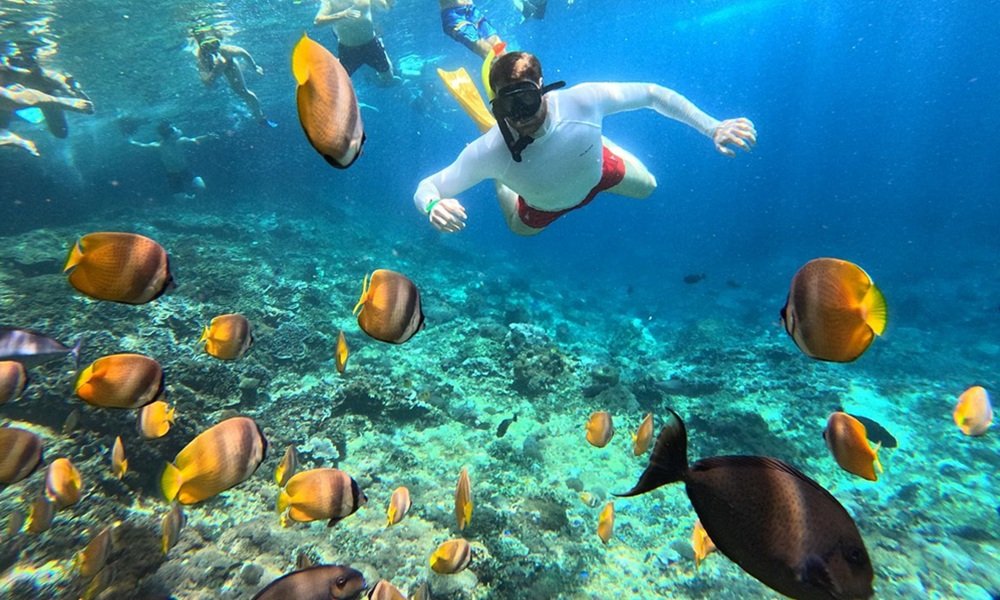
The island also offers coral reefs, tropical fish, turtles, and other marine life.
This is why a multi-location snorkeling itinerary can be a good idea.
If the mantas are not visible, you may still have excellent reef snorkeling at another location.
If your entire day depends emotionally on seeing one particular animal, disappointment becomes much more likely.
Instead, treat the manta encounter as a possibility rather than a promise.
Then anything you see becomes a bonus.
Manta Snorkeling Is Different From Diving
Divers experience manta rays from below, while snorkelers normally observe them from the surface.
Neither is automatically better.
Snorkeling has a unique advantage: you remain close to the surface and can watch a manta pass underneath.
You also do not need scuba certification.
Diving can provide a different perspective because divers may spend more time at depth around a cleaning station.
For visitors who simply want the experience of watching a manta ray in the ocean, snorkeling can be more than enough.
The important thing is selecting an activity that matches your abilities and comfort level.
Who Should Consider a Manta Snorkeling Trip?
A manta-focused snorkeling trip can be particularly appealing to:
- First-time visitors to Nusa Penida
- Wildlife enthusiasts
- Underwater photographers
- Families with suitable swimming ability
- Couples looking for a memorable ocean experience
- Travelers who prefer snorkeling to scuba diving
However, suitability depends on the day’s conditions.
Someone who is uncomfortable in open water may find a boat-based manta trip challenging even if they are otherwise interested in marine life.
Be honest about your ability before joining.
A good operator can help determine whether the current conditions and itinerary are appropriate.
What Should You Do During the Encounter?
When a manta appears, the best thing you can do is surprisingly simple.
Stop.
Float.
Watch.
Keep your breathing controlled.
Avoid sudden movements.
Do not chase the animal.
Allow it to move through the area naturally.
If you have a camera, take a few photographs but do not let the camera completely distract you.
The experience may last only a short time.
Sometimes the manta disappears almost as quickly as it appeared.
Put the camera down occasionally and simply watch.
You may remember that moment more clearly than the photograph.
Responsible Manta Watching
Wildlife tourism is most valuable when it does not harm the animals being observed.
Keep a respectful distance.
Do not touch manta rays.
Do not block their path.
Do not surround them with a large group.
Do not attempt to force a close encounter for a photograph.
If the animal changes direction because of your presence, give it space.
Your goal is observation, not interaction.
A manta ray does not need to know that you were there.
That is actually a sign of a successful wildlife encounter.
Choosing an Operator Matters
Because Nusa Penida is popular, many Nusa Penida snorkeling tour operators offer manta trips.
The quality of the experience can vary.
Look for an operator that places safety and responsible wildlife observation ahead of guaranteed sightings.
A professional crew should be willing to change the itinerary when sea conditions are unsuitable.
They should explain the rules before entering the water.
They should also help guests understand how to behave around manta rays.
Do not automatically choose a trip simply because it promises the closest possible encounter.
The best experience is one where the animal’s welfare and visitor safety are treated as priorities.
Combine Manta Watching With Other Snorkeling Locations
A manta-focused trip does not have to be limited to manta rays.
Nusa Penida’s marine environment offers several different snorkeling locations, and combining them can create a more varied day.
You might spend part of the trip looking for manta rays and another part exploring coral reefs and smaller marine life.
This approach makes the day more rewarding because you are not relying on a single wildlife encounter.
For a broader comparison of the island’s underwater destinations, see our guide to the Best Snorkeling Spots in Nusa Penida.
Understanding the characteristics of each location can help you choose an itinerary that matches your interests.
The Experience Is About More Than Seeing a Manta
There is something special about encountering a large wild animal in its natural environment.
You cannot predict exactly when it will appear.
You cannot control where it will swim.
You cannot ask it to repeat the moment for your camera.
That unpredictability creates a sense of genuine adventure.
A manta ray may glide directly beneath you.
It may appear in the distance and disappear.
You may see one.
You may see several.
Or you may spend the day enjoying coral reefs and tropical fish without a manta encounter.
All of these are real ocean experiences.
So, Can You See Manta Rays in Nusa Penida?
Yes—and Nusa Penida is one of the strongest places in Bali to try.
Manta Point is the island’s most famous manta location, and current local information indicates that manta rays can be encountered throughout the year, sometimes in relatively shallow water near the surface.
But the correct expectation is not “I am guaranteed to see a manta.”
Instead, think:
“I am visiting one of the places where my chances are genuinely good.”
That mindset makes the experience much more enjoyable.
Choose a suitable day, follow local guidance, remain patient, and let the ocean determine what happens.
If a manta eventually appears beneath you, resist the urge to chase it.
Simply float and watch.
For a few moments, the entire trip may become about one enormous animal quietly flying through the blue water below.
And that is precisely the kind of encounter that makes snorkeling around Nusa Penida so memorable.
Yes, manta rays can be seen while snorkeling around Nusa Penida, particularly around Manta Point. Encounters can occur throughout the year, but sightings are never guaranteed. The best approach is to choose a reputable local operator, follow wildlife guidelines, respect the animals, and enjoy Nusa Penida’s other marine life as part of the adventure.