

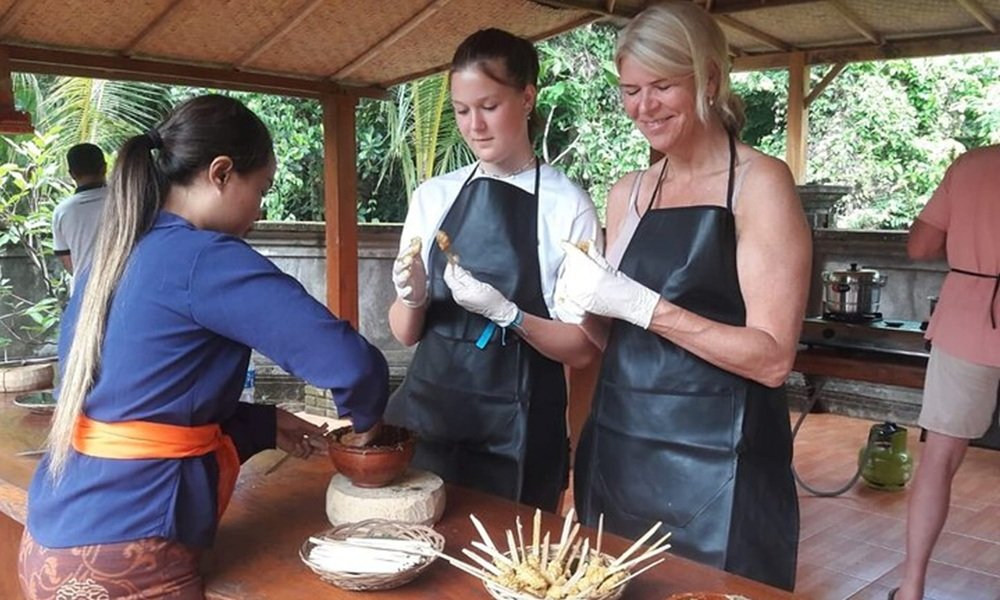
Best Bali Cooking Classes for Beginners
The Best Bali Cooking Classes for Beginners are a wonderful way to discover the island through its food while learning practical techniques you can use long after your vacation ends. Instead of simply ordering traditional dishes at restaurants, a cooking class lets you participate in the process, work with local ingredients, and understand how Balinese flavors are created.
For first-time visitors, the Bali experiences can be surprisingly accessible. You do not need professional kitchen skills or extensive knowledge of Indonesian cuisine. A good beginner class explains each step clearly, provides the necessary equipment, and gives you plenty of opportunities to prepare the food yourself.
What makes a Bali cooking class experience especially interesting is the connection between food, local markets, agriculture, family traditions, and daily life. Depending on the class you choose, your day may begin at a traditional market before continuing into a hands-on kitchen session.
Best Bali Cooking Classes for Beginners: What to Look For
Not every cooking class offers the same experience.
Some are designed mainly as demonstrations, while others encourage participants to prepare nearly every component themselves. Some include market visits, and others focus entirely on cooking.
For beginners, hands-on participation is usually the most valuable option.
Look for a class where the instructor explains unfamiliar ingredients, demonstrates techniques, and then gives you time to repeat them.
The size of the group also matters.
A smaller group can make it easier to ask questions and receive individual guidance. Large classes can still be enjoyable, but you may spend more time watching than cooking.
Before booking, check the menu as well. If your goal is to learn specifically about Balinese cuisine, choose a class that includes several local dishes rather than a general Indonesian cooking session.
Morning Market Experiences
One of the most interesting formats combines a traditional market visit with a cooking lesson.
The experience often begins early because local markets are most active in the morning.
Instead of arriving at a kitchen where every ingredient has already been prepared, you get to see where some of the food begins.
Your instructor can explain the difference between various chilies, herbs, roots, vegetables, and spices.
You may encounter ingredients that you have never used before.
The market visit also gives you an opportunity to observe everyday life in Bali. Vendors arrange produce, customers select ingredients, and local cooks shop for what they need for the day.
Afterward, the ingredients can become part of your cooking session.
This creates a natural connection between shopping and cooking.
Traditional Village Cooking Classes
For travelers who want a more cultural experience, a village-based cooking class can be particularly rewarding.
These experiences may take place in a traditional family compound or a rural setting surrounded by rice fields.
The atmosphere is often very different from a commercial cooking studio.
You may learn about local ingredients while seeing how food preparation fits into everyday community life.
Some classes include explanations of traditional kitchens, cooking equipment, or family customs.
The experience can feel less formal than a professional culinary workshop.
You are not simply learning recipes.
You are learning how food fits into a particular way of life.
Classes Designed Specifically for First-Timers
Beginners should not feel pressured to choose an advanced culinary experience.
A suitable class should explain basic techniques rather than assume you already understand Indonesian cooking.
For example, your instructor might show you how to safely chop lemongrass, prepare fresh chilies, crush spices, or balance seasoning.
You may also learn why certain ingredients are cooked together and how the order of preparation affects the final flavor.
The instructor should be comfortable answering basic questions.
If you have never encountered ingredients such as galangal, turmeric root, candlenut, or kaffir lime before, there is nothing unusual about asking what they are and how they are used.
In fact, discovering unfamiliar ingredients is one of the most enjoyable parts of the experience.
Learning to Make a Balinese Spice Paste
One of the most valuable skills you can take away from a cooking class is understanding how Balinese spice mixtures are prepared.
Many dishes begin with an aromatic combination of ingredients rather than a bottled sauce.
Fresh shallots, garlic, turmeric, ginger, galangal, chilies, lemongrass, and other ingredients may be combined into a paste.
Traditionally, these ingredients can be ground using a mortar and pestle.
The process takes physical effort, but it also allows you to experience the aromas directly.
As the ingredients are crushed, their oils and fragrances become increasingly noticeable.
You begin to understand why freshly prepared spices can produce such distinctive flavors.
A beginner class should explain not only what goes into the mixture but also how it should look and smell before cooking.
Cooking Sate Lilit
Sate lilit is an excellent dish for beginners because the preparation is interactive.
Instead of placing pieces of meat on a skewer, the seasoned mixture is wrapped around a stick or stalk.
Fish, chicken, pork, and other variations can be used depending on the recipe.
The mixture may be combined with coconut and Balinese spices before being shaped around the skewer.
This is a hands-on process, so everyone gets involved.
You can also learn how the mixture should be compressed so it stays attached during grilling.
The finished sate is fragrant, lightly charred on the outside, and packed with seasoning.
For many visitors, making sate lilit becomes one of the most memorable parts of the class.
Preparing Fresh Sambal
If you enjoy spicy food, learning to make Balinese sambal can be one of the highlights.
Sambal is not simply a sauce used to add heat.
Different sambals have different textures, aromas, and levels of acidity.
Sambal matah is particularly associated with Bali and uses fresh ingredients such as shallots, chilies, lemongrass, lime, and aromatic leaves.
Rather than being cooked into a thick paste, the ingredients are sliced and combined.
The result is fresh, spicy, fragrant, and acidic.
A cooking class can teach you how to balance these flavors instead of simply increasing the amount of chili.
That is an important lesson for beginners.
Spiciness should complement the other ingredients rather than overpower them.
Vegetarian Cooking Classes
Vegetarian travelers have plenty of opportunities to explore Balinese food.
A dedicated vegetarian cooking class can introduce you to vegetables, tofu, tempeh, coconut, herbs, rice, spices, and sambals.
This can be especially interesting because it shows how much variety exists beyond the island’s famous meat dishes.
You may prepare vegetable-based side dishes, seasoned tofu, coconut preparations, and fresh sambals.
Some Bali cooking class also offer vegan menus.
If you follow a specific diet, communicate your requirements before booking.
This gives the instructor enough time to adjust the menu and avoid ingredients that you cannot eat.
Private Cooking Classes
A private class can be an excellent choice if you want a more personalized experience.
Instead of following a fixed group schedule, you may have more flexibility regarding the menu, pace, and level of instruction.
This can be particularly useful if you are traveling as a couple or family.
A private instructor can spend more time correcting techniques and answering individual questions.
It can also be easier to accommodate dietary restrictions.
The main disadvantage is usually the higher price compared with a group class.
However, if cooking is one of the main activities you want to experience in Bali, the additional personal attention may be worthwhile.
Family-Friendly Cooking Experiences
Cooking classes can work surprisingly well for families.
Children can participate in simple tasks such as mixing ingredients, shaping food, grinding spices with supervision, or preparing certain vegetables.
The experience gives families something active to do together instead of simply visiting another attraction.
Parents should choose a class appropriate for their children’s age.
Very young children may become tired during a long cooking session, while older children may enjoy learning more complex techniques.
A relaxed environment is usually better than a highly formal culinary school.
The goal is to have fun while discovering Balinese food.
Cooking Classes for Couples
A cooking class can also be a good activity for couples looking for something different from the usual Bali itinerary.
Instead of spending another afternoon at a beach or restaurant, you can prepare a meal together.
Working on different dishes gives both people opportunities to participate.
One person might prepare the spice paste while the other works on vegetables or satay.
At the end, you can sit down and enjoy the meal you prepared.
The experience creates a shared memory, which is often more meaningful than simply taking another photograph at a tourist attraction.
Cooking in Ubud or Beyond
Ubud is particularly associated with culinary and cultural experiences, and visitors can find many cooking classes in and around the area.
Its surrounding villages and agricultural landscapes also make it a natural setting for classes that combine food with local culture.
However, you do not necessarily need to stay in Ubud to enjoy a cooking experience.
Other parts of Bali also offer classes, including areas closer to the coast and tourist centers.
The best location depends on your itinerary.
There is little point booking a class several hours away if you are staying on the opposite side of the island unless the specific experience is especially important to you.
What You Should Expect to Learn
A good beginner class should leave you with practical knowledge rather than simply a collection of printed recipes.
You should understand how Balinese cooks build flavor.
You may learn how fresh spices are prepared, how coconut is used, when herbs are added, and how heat affects different ingredients.
You may also learn how several dishes are served together.
Balinese meals often include multiple components with different textures and flavors.
A spicy sambal might accompany a mild vegetable dish, while rice provides a neutral base.
Understanding these relationships helps you recreate the experience at home.
Market-to-Table Cooking
Market-to-table experiences can be especially educational.
You see ingredients in their original form before they are transformed into finished dishes.
For example, turmeric may appear as a fresh root rather than the powdered spice commonly found in Western supermarkets.
Galangal may look unfamiliar.
Fresh lemongrass, chilies, herbs, and coconut may be presented in forms you have never purchased before.
The instructor can explain how to identify good ingredients and how they should be prepared.
Once you enter the kitchen, those same ingredients become part of your meal.
This creates a satisfying sense of progression from market to plate.
What About Cooking Equipment?
You generally do not need to bring your own equipment.
Cooking classes provide knives, cutting boards, pans, cooking utensils, and other necessary tools.
Some traditional experiences may use a mortar and pestle instead of an electric food processor.
This is useful because you get to experience the traditional technique rather than simply watching a modern machine do the work.
You should wear comfortable clothing.
Cooking can become messy, particularly when working with chilies, coconut, and spice pastes.
Closed footwear may also be preferable in a professional kitchen environment.
How Long Does a Bali Cooking Class Usually Take?
Cooking classes vary in length.
A short session may focus on a few dishes, while a market-to-kitchen experience can occupy several hours.
Do not automatically choose the shortest option.
The amount of time available can affect how much you actually learn.
A rushed class may give you enough time to taste several dishes but not enough time to understand the preparation process.
For beginners, a moderate-length experience is often a good balance.
You have enough time to learn without becoming exhausted.
If the experience includes transportation or a market visit, remember to allow additional time in your daily itinerary.
What Makes a Cooking Class Worthwhile?
Price alone does not determine the quality of a cooking experience.
Look at what is included.
Does the class include a market visit?
Is it hands-on?
How many people are in the group?
How many dishes will you prepare?
Are ingredients included?
Is transportation provided?
Does the instructor explain the cultural background of the food?
These details can make two classes with similar prices feel completely different.
The best experience is one that matches your interests rather than simply being the cheapest option available.
Learning Beyond the Recipe
One of the most valuable parts of a Balinese cooking class is learning to cook without relying entirely on precise measurements.
Traditional cooking often involves adjusting ingredients according to taste.
You may add more lime because the dish needs acidity.
You may reduce the chili because the heat is becoming too strong.
You may add salt gradually until the flavors become balanced.
This teaches an important culinary skill: tasting and adjusting.
Once you understand the basic flavor structure, you can become more confident experimenting in your own kitchen.
Bringing the Experience Home
A cooking class becomes even more valuable when you continue using what you learned after returning home.
You can recreate a sambal for a family dinner or prepare a Balinese-inspired rice meal.
Some ingredients may require substitutions depending on what is available in your country.
That is perfectly normal.
The goal is not necessarily to reproduce a dish with laboratory-level precision.
The goal is to understand its character.
Once you know how the flavors work together, you can adapt the recipe while keeping its Balinese inspiration.
Food and Balinese Culture
Food is deeply connected with Balinese life.
Cooking traditions can be passed through families, and particular dishes may be associated with ceremonies, celebrations, community gatherings, or everyday meals.
A cooking class gives visitors an opportunity to learn about these connections.
This cultural context makes the experience much richer.
Instead of simply learning that a particular dish contains certain ingredients, you begin to understand why it is prepared and when it might be served.
That knowledge can change the way you appreciate Balinese food when you encounter it in restaurants or local homes.
Traditional Balinese Dishes Worth Learning
The exact menu will depend on your chosen class, but several dishes are particularly useful for visitors who want to explore local cuisine.
Sate lilit offers a hands-on introduction to seasoned mixtures and grilling.
Sambal matah demonstrates how fresh ingredients can create intense flavor without lengthy cooking.
Lawar introduces the combination of vegetables, coconut, spices, and other ingredients.
Pepes and tum demonstrate traditional leaf-wrapping techniques.
Nasi campur shows how several components can be combined into one complete meal.
Learning a mixture of dishes provides a broader understanding of Balinese cuisine than focusing on one recipe.
The Best Bali Cooking Classes for Beginners are not simply about preparing lunch or dinner. They offer an opportunity to understand Bali through ingredients, traditional techniques, local markets, and food culture.
Whether you choose a market-to-table experience, a village class, a private session, or a family-friendly workshop, look for an experience that allows you to participate rather than simply watch.
You do not need advanced cooking skills.
Curiosity is enough.
By the end of a good class, you should have learned how local spices are combined, how traditional dishes are prepared, and how Balinese cooks balance heat, aroma, acidity, sweetness, and texture.
Most importantly, you can take those skills home with you.
If you want to explore the dishes and techniques you may encounter during a Bali cooking experience, read our guide to Traditional Balinese Dishes You Will Learn to Cook before choosing your class.