

Traditional Balinese Dishes You Will Learn to Cook
Traditional Balinese Dishes You Will Learn to Cook offer a delicious introduction to the island’s culture, ingredients, and everyday culinary traditions. Balinese cuisine is known for its bold flavors, aromatic herbs, fresh spices, and carefully prepared spice pastes. A cooking class in Bali is therefore more than simply following recipes. It is an opportunity to understand how local ingredients are combined and why certain dishes have such an important place in Balinese life.
From fragrant rice dishes to richly seasoned meats, vegetables, and traditional sambals, Balinese food has remarkable variety. Many dishes use a combination of garlic, shallots, ginger, turmeric, galangal, chilies, lemongrass, and other aromatic ingredients.
You do not need professional cooking experience to enjoy a Bali cooking class. Most classes are designed to introduce visitors to the techniques and flavors of local cuisine in an approachable way.
Traditional Balinese Dishes You Will Learn to Cook
A typical Balinese cooking experience may include several dishes rather than just one. The exact menu depends on the cooking school, location, season, and whether you choose a vegetarian or meat-based class.
Some classes begin with a visit to a local market, where participants learn about unfamiliar ingredients before entering the kitchen.
Others start directly with preparation.
Either way, the experience usually focuses on fresh ingredients and traditional preparation methods.
You may learn how to prepare a spice paste from scratch, chop herbs correctly, balance spicy and savory flavors, and combine ingredients at different stages of cooking.
The most interesting part is often discovering that several dishes share a similar foundation but taste completely different depending on how the ingredients are prepared.
Babi Guling: Bali’s Famous Roast Pork
Babi guling is one of Bali’s best-known dishes.
Traditionally, a whole pig is seasoned with a complex mixture of spices and herbs before being slowly roasted. The result combines crisp skin with tender, highly seasoned meat.
Because preparing a whole roasted pig is a substantial process, visitors do not necessarily cook the entire dish during a standard cooking class.
Instead, a class may introduce the spice mixture, preparation techniques, or components commonly served alongside babi guling.
The seasoning typically includes aromatic ingredients such as turmeric, garlic, shallots, ginger, galangal, chilies, and other local spices.
Babi guling is strongly associated with Balinese celebrations and ceremonial occasions, although it is also available at restaurants and local food stalls.
For visitors interested in Balinese culinary traditions, understanding the dish provides insight into how food can connect with community events and cultural practices.
Lawar and Its Colorful Ingredients
Lawar is another important Balinese dish that visitors may encounter during a cooking experience.
It is generally made by combining finely chopped vegetables with coconut, herbs, spices, and other ingredients. Different versions can contain meat, while vegetarian preparations are also common.
One of the fascinating things about lawar is its variety.
Recipes differ between communities and families, so there is no single version that represents every preparation.
A cooking class Bali experiences can demonstrate how finely ingredients should be chopped and how the seasoning is incorporated.
The balance between fresh vegetables, coconut, aromatic spices, and savory ingredients creates a texture and flavor combination that is very different from many Western salads.
Lawar is often served as part of a larger meal rather than as an isolated dish.
Pepes: Food Wrapped in Leaves
Pepes is a traditional cooking technique found in Indonesian cuisine, including Bali.
Ingredients are seasoned with spices, wrapped in leaves, and then steamed or cooked until the flavors develop.
Fish is a popular choice, although other ingredients can also be prepared using this method.
Banana leaves play an important role because they help contain the ingredients while contributing a subtle aroma.
The preparation itself is part of the experience.
Instead of simply placing ingredients in a pan, you learn how to arrange, fold, and secure the leaf package before cooking.
When the package is opened, the steam releases the fragrance of the spices.
This technique demonstrates how traditional cooking often relies on simple natural materials rather than complicated kitchen equipment.
Sate Lilit: A Balinese Specialty
Sate lilit is one of the most recognizable Balinese satay dishes.
Unlike conventional skewered satay, the seasoned mixture is wrapped or pressed around a bamboo stick, skewer, or sometimes a lemongrass stalk.
Fish is commonly used, although chicken, pork, and other variations can be found.
The mixture is combined with coconut and aromatic spices before being shaped around the skewer.
Learning to make sate lilit can be especially enjoyable because the preparation is hands-on.
You are not simply watching someone cook.
You are working directly with the ingredients and learning how the mixture should feel before it is cooked.
The finished satay is typically grilled over heat, producing a fragrant exterior while keeping the inside moist.
Tum: A Traditional Steamed Preparation
Tum is another dish that demonstrates the importance of banana leaves in Bali cooking class.
Seasoned meat, fish, or other ingredients are wrapped in banana leaves and steamed.
The cooking process allows the flavors to develop gradually.
Unlike deep-fried food, steaming keeps the preparation relatively moist while allowing the spice mixture to remain prominent.
During a cooking class, making the banana-leaf package can be one of the more memorable activities.
You learn how to portion the filling, fold the leaves, and secure the package before placing it in the steamer.
The technique is simple once demonstrated, but getting the folds right can take a little practice.
Balinese Vegetable Dishes
Balinese cooking is not exclusively about meat.
Vegetables play an important role in many traditional meals, and vegetarian cooking classes can introduce visitors to a wide range of local produce.
Common ingredients can include long beans, water spinach, bean sprouts, eggplant, spinach, coconut, and other seasonal vegetables.
The distinctive element is often the seasoning.
Instead of relying on heavy sauces, vegetables can be combined with fresh spices, roasted coconut, chilies, garlic, and shallots.
This creates dishes with considerable depth despite using relatively simple ingredients.
A vegetarian cooking class can therefore be an excellent way to explore Balinese food without focusing on meat or seafood.
Sambal Matah: Fresh Balinese Sambal
Sambal matah is one of Bali’s most distinctive condiments.
Unlike sambals that are cooked into a thick sauce, sambal matah is a fresh preparation made from ingredients such as shallots, chilies, lemongrass, lime, and aromatic leaves.
Its flavor is bright, spicy, fresh, and fragrant.
The preparation demonstrates an important principle of Balinese cooking: ingredients do not always need extensive cooking to create intense flavor.
The ingredients are finely sliced and combined carefully.
The balance is important.
Too much chili can overwhelm the other flavors, while too little acidity can make the mixture feel heavy.
Learning to make sambal matah can also change the way you approach other meals because it is easy to prepare and can accompany many different foods.
Base Genep: The Heart of Balinese Flavor
One of the most interesting things you may learn in a Balinese cooking class is how to prepare a traditional spice mixture often known as base genep.
This aromatic paste forms the foundation of many Balinese dishes.
It can include ingredients such as shallots, garlic, turmeric, ginger, galangal, candlenut, chilies, lemongrass, and other spices.
The exact recipe varies.
The ingredients are traditionally ground together to create a fragrant paste before being cooked.
This process helps release the oils and aromas contained in the spices.
Understanding base genep gives visitors a deeper appreciation for Balinese cuisine because it reveals that the flavor of many dishes begins long before the main ingredient enters the pan.
The spice paste is essentially part of the culinary architecture of the meal.
Nasi Campur Bali
Nasi campur is a mixed rice meal that can contain several different components.
A plate may include rice alongside vegetables, meat, satay, sambal, egg, and other side dishes.
There is no single universal combination.
That flexibility is part of its appeal.
In a cooking class, you may prepare several components that are later arranged around rice.
This teaches an important aspect of Indonesian dining: a meal can contain multiple textures and flavors at the same time.
Something spicy may sit next to something savory, while fresh vegetables provide contrast.
Rather than thinking about one dish in isolation, you begin to understand how different foods work together as a complete meal.
Balinese Coconut and Spice Combinations
Coconut appears frequently in Balinese cuisine.
Fresh coconut, coconut milk, grated coconut, and roasted coconut can all contribute different characteristics.
Roasted coconut can add a nutty aroma, while coconut milk creates richness and a smooth texture.
When combined with chilies and aromatic spices, coconut helps balance heat and create complexity.
Cooking classes may demonstrate how to prepare coconut for different recipes.
This is another example of traditional cooking making full use of available ingredients.
Instead of treating one ingredient as useful for only one purpose, Balinese cooking often uses it in several different ways.
Traditional Cooking Tools and Techniques
The food itself is only part of the story.
Traditional preparation methods are equally interesting.
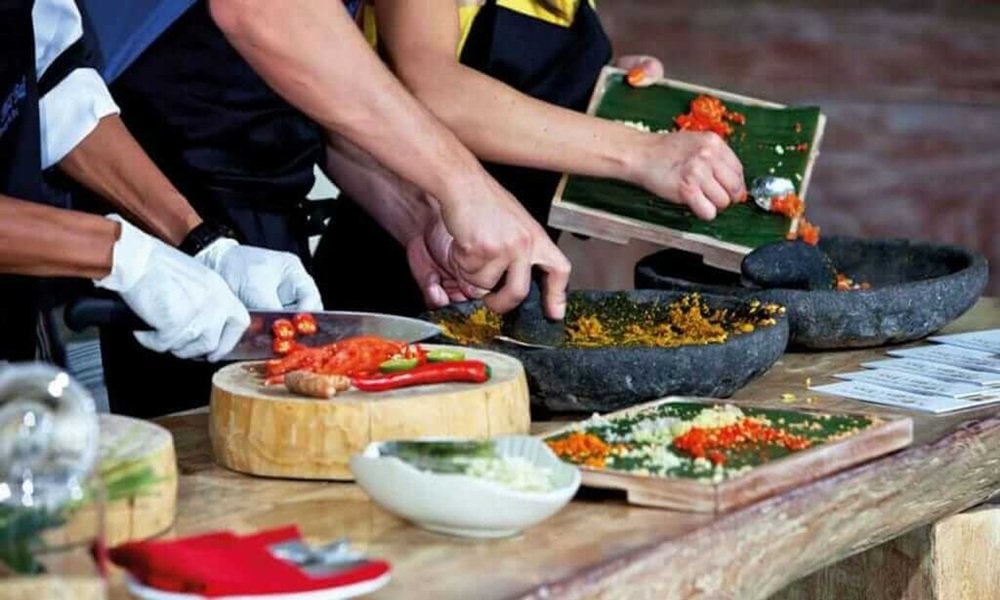
Visitors may have the opportunity to use a mortar and pestle to grind spices rather than relying entirely on an electric blender.
Grinding ingredients manually can take longer, but it provides a different sensory experience.
You can smell the spices as they are crushed and see how their texture changes.
Some classes may also demonstrate traditional charcoal or wood-fired cooking, although modern kitchens are common as well.
The point is not to recreate a historical kitchen perfectly.
It is to understand how local cooking techniques developed and why certain methods remain important.
Why Fresh Spices Matter
One of the reasons Balinese food tastes so distinctive is the use of fresh aromatic ingredients.
Dried spices have their place, but fresh ginger, turmeric, galangal, lemongrass, chilies, shallots, and garlic contribute bright aromas that can be difficult to reproduce with prepackaged seasoning.
When you prepare these ingredients yourself, you immediately notice the difference.
The fragrance released when fresh spices are crushed is part of the cooking experience.
This is why many Balinese cooking classes place considerable emphasis on preparation rather than simply teaching when to add ingredients to a pan.
Vegetarian Options for Cooking Classes
Visitors who do not eat meat can still enjoy a substantial Balinese culinary experience.
Many traditional dishes have vegetarian variations, and cooking schools may offer dedicated vegetarian menus.
Vegetables, tofu, tempeh, coconut, spices, rice, and sambals provide plenty of possibilities.
A vegetarian class can also highlight ingredients that might otherwise be overshadowed by famous meat dishes.
You may discover that Balinese cuisine has much more variety than the dishes most commonly advertised to international tourists.
If you have dietary restrictions or allergies, communicate them to the cooking school before the class.
That allows the instructor to prepare appropriate ingredients and avoid unnecessary confusion during the lesson.
From Market to Kitchen
Some cooking experiences include a traditional market visit before the actual lesson.
This can be one of the most valuable parts of the experience.
Instead of seeing ingredients only after they have been cleaned and prepared, you can observe how local produce is displayed and sold.
You may encounter unfamiliar herbs, roots, fruits, vegetables, chilies, and spices.
The instructor can explain which ingredients are essential for the dishes you will prepare.
Afterward, you can take those ingredients into the kitchen and see how they are transformed.
The connection between market and meal makes the experience feel much more complete.
You are not merely following a recipe.
You are seeing part of the journey from raw ingredient to finished food.
What You Really Learn in a Balinese Cooking Class
A good cooking class should leave you with more than a few recipes.
You should understand how flavors are constructed.
You may learn that a spice paste needs to be cooked patiently rather than rushed. You may discover why fresh herbs are added at a particular stage or why coconut is toasted before being incorporated into a dish.
You also learn about balance.
Balinese food can be spicy, but heat is only one part of the flavor profile.
Sweetness, saltiness, acidity, aroma, texture, and richness all interact.
Once you understand these principles, you can experiment with the recipes at home rather than simply trying to reproduce them word for word.
Bringing Balinese Cooking Home
One of the best things about a cooking class is that the experience does not have to end when you leave Bali.
Many of the ingredients used in Balinese dishes are available internationally.
You may need to visit an Asian grocery store or specialty market to find fresh galangal, kaffir lime, candlenut, or particular varieties of chilies.
However, once you understand the basic techniques, substitutions become easier.
The recipes also give you a way to remember your trip.
Preparing sambal matah at home, for example, can instantly bring back memories of Bali’s flavors and aromas.
A cooking class can therefore become a lasting souvenir rather than a one-day activity.
Food as Part of Balinese Culture
Food in Bali is closely connected with family, community, ceremonies, and daily life.
Certain dishes are prepared for special occasions, while others are common parts of everyday meals.
Learning about these connections adds another dimension to a cooking class.
You begin to understand why recipes are not always written down in exactly the same way.
Family traditions, local ingredients, and personal preferences can all influence how a dish is prepared.
That flexibility is part of the character of Balinese cuisine.
The recipe is important, but the knowledge passed from one cook to another is equally valuable.
Choosing a Balinese Cooking Experience
When selecting a cooking class, consider what you want to get from the experience.
If you are interested in traditional techniques, look for a class that emphasizes local ingredients and hands-on preparation.
If food is your primary interest, a market tour can add significant value.
Vegetarians should look for a menu specifically designed around plant-based dishes rather than simply removing meat from standard recipes.
Small-group classes can also provide more interaction with the instructor.
Most importantly, choose an experience that gives you enough time to participate.
Watching someone prepare food is enjoyable, but actually grinding spices, shaping sate lilit, wrapping banana leaves, and preparing sambal will make the experience much more memorable.
Traditional Balinese Dishes You Will Learn to Cook provide a fascinating introduction to the island’s culinary heritage. From sate lilit and lawar to pepes, sambal matah, nasi campur, and aromatic spice pastes, each preparation reveals something about local ingredients and cooking traditions.
The real value of a Balinese cooking class is not simply the food you eat at the end.
It is the process.
You discover how fresh ingredients are selected, how spices are combined, how traditional techniques influence flavor, and how food connects with everyday Balinese culture.
Whether you are an experienced home cook or someone who normally avoids the kitchen, a hands-on cooking experience can be an enjoyable way to explore Bali beyond its beaches and tourist attractions.
And once you return home, you can recreate some of those flavors and share a little piece of your Bali experience with family and friends.
For travelers planning several outdoor activities during their Bali vacation, you can also explore our guide to the Best Time of Year for Surfing in Bali and discover when seasonal conditions are most suitable for enjoying the island’s waves.