

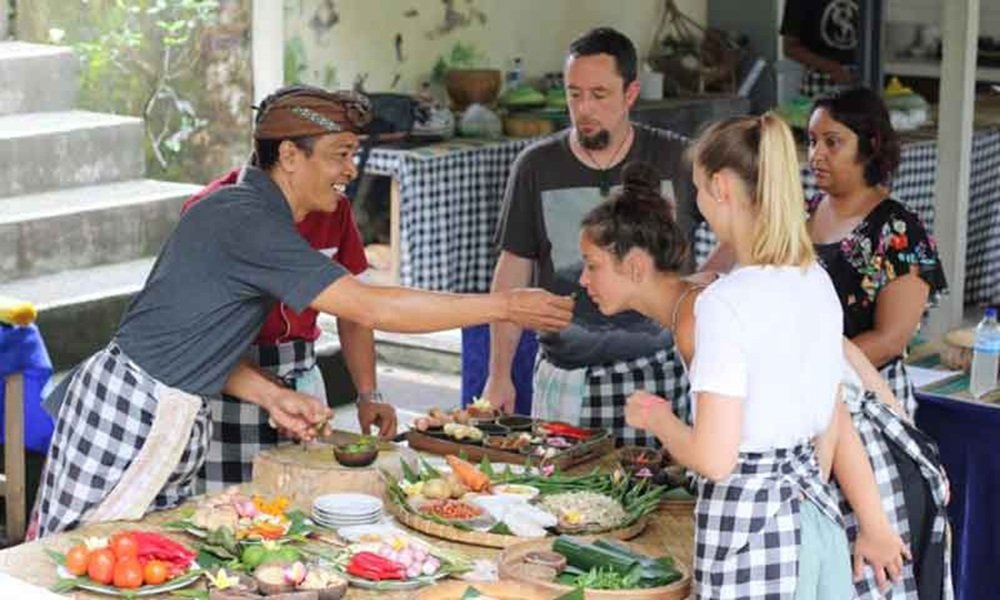
What to Expect in a Bali Cooking Class
Knowing What to Expect in a Bali Cooking Class can help you arrive prepared and enjoy the experience without wondering what will happen next. A Balinese cooking experience is usually much more than standing in a kitchen and following a recipe. Depending on the class you choose, you may visit a traditional market, learn about unfamiliar spices, prepare food from scratch, and sit down afterward to enjoy the meal you helped create.
For travelers who have never cooked Indonesian food before, the Bali experiences can initially seem unfamiliar. Ingredients such as galangal, turmeric, lemongrass, candlenut, fresh chilies, and aromatic leaves may not be part of your normal kitchen routine.
That is exactly what makes a cooking class interesting.
Instead of simply tasting Balinese cuisine at a restaurant, you get to discover how its flavors are built and why certain ingredients are used together.
What to Expect in a Bali Cooking Class From Start to Finish
The exact schedule depends on the cooking school, but most experiences follow a fairly natural progression.
You may begin with a pickup from your accommodation or meet the group at the cooking location. If the class includes a market visit, this usually happens before the kitchen session.
Once the ingredients have been gathered, the instructor introduces the menu and explains what you will be preparing.
The cooking then begins.
You may spend time washing, peeling, chopping, grinding, mixing, wrapping, and cooking the ingredients.
Rather than watching the instructor complete every dish, a hands-on class normally allows participants to perform many of the steps themselves.
Once everything is ready, the group sits down to eat.
Some experiences also provide recipe cards or digital recipes so you can recreate the dishes after returning home.
Arriving at the Cooking Location
The atmosphere can vary considerably depending on the type of class.
A professional cooking school may have a dedicated kitchen with individual workstations.
A village-based experience may take place in a family compound or outdoor kitchen.
Neither approach is necessarily better.
A modern kitchen can be convenient and organized, while a traditional setting can provide more cultural context.
When you arrive, the instructor will usually explain the schedule and introduce the dishes you will prepare.
This is a good opportunity to mention dietary restrictions, allergies, or foods you cannot eat.
Do not wait until the cooking is already underway.
Letting the instructor know in advance makes it much easier to adjust the menu safely.
A Visit to a Traditional Market
Some of the most memorable Bali cooking class experiences begin outside the kitchen.
A market visit gives you a chance to see ingredients in their everyday environment.
You might encounter piles of fresh chilies, tropical fruits, vegetables, herbs, roots, spices, and coconuts.
Some ingredients may look completely unfamiliar.
Your instructor can explain what they are, how they are selected, and how they will be used in the recipes.
You may also see local shoppers purchasing ingredients for their households.
This makes the market visit more than a shopping trip.
It provides a glimpse into ordinary food culture.
Not every cooking class includes a market visit, so check the itinerary before booking if this is important to you.
Learning to Recognize Local Ingredients
One of the first challenges for beginners is identifying ingredients they have never used before.
Fresh turmeric, for example, looks very different from the yellow powder commonly found in supermarkets.
Galangal resembles ginger but has a distinct flavor and aroma.
Lemongrass may be familiar to some visitors, but knowing which part to use and how to prepare it is another matter.
Your instructor can demonstrate these differences.
You may smell several ingredients individually before combining them.
This is an important part of learning because Balinese cooking relies heavily on aromatic ingredients.
Once you understand their individual characteristics, you begin to appreciate how they work together.
Preparing the Spice Mixture
One of the most hands-on parts of a cooking class is preparing the spice mixture.
Balinese cuisine often begins with a combination of fresh aromatics rather than a ready-made sauce.
Shallots, garlic, turmeric, ginger, galangal, chilies, lemongrass, candlenut, and other ingredients can be combined according to the recipe.
Traditionally, a mortar and pestle may be used.
Grinding the ingredients manually takes more time than using a blender, but it gives you a much better understanding of the traditional process.
You can see the ingredients gradually change from separate pieces into a fragrant paste.
The instructor may also explain how the texture should look and how long the mixture needs to cook.
You Will Probably Do More Work Than Expected
Some travelers imagine a cooking class as a demonstration where they watch an instructor prepare everything.
A hands-on experience is different.
You may spend a significant portion of the session chopping vegetables, grinding spices, mixing ingredients, shaping food, and preparing banana-leaf packages.
This is a good thing.
The purpose is to learn by doing.
You may make mistakes along the way.
Your spice paste might be too coarse.
Your vegetables might be cut unevenly.
Your first attempt at wrapping food in a banana leaf may not look particularly elegant.
That is part of the experience.
The instructor is there to guide you.
Learning to Make Several Dishes
Most cooking classes prepare more than one dish.
This allows you to experience different techniques during the same session.
For example, you might prepare a rice dish, a vegetable preparation, a satay, and a sambal.
One dish may require grilling while another involves steaming or stir-frying.
The variety keeps the class interesting.
It also gives you a broader understanding of Balinese cuisine.
Rather than thinking about one recipe, you begin to see how several components can work together to form a complete meal.
Sate Lilit May Be Part of the Experience
If your class includes sate lilit, you will probably have an opportunity to prepare the mixture yourself.
Unlike conventional satay made from chunks of meat, sate lilit uses a seasoned mixture that is shaped around a skewer or stalk.
The mixture may include coconut and aromatic spices.
You will learn how to form it around the stick so that it stays attached during cooking.
The shaping process is surprisingly tactile.
Once prepared, the satay is grilled until fragrant.
It is a good example of how traditional Balinese dishes combine simple cooking methods with complex seasoning.
You May Learn a Fresh Sambal
Sambal is an important part of Indonesian cuisine, and Bali has its own distinctive preparations.
A cooking class may introduce you to a fresh sambal made from ingredients such as chilies, shallots, lemongrass, lime, and aromatic leaves.
The ingredients are generally prepared and combined rather than cooked into a thick sauce.
This creates a fresh and lively flavor.
The instructor may encourage you to taste the sambal and adjust the balance.
You might discover that adding acidity can change the overall character of the dish dramatically.
This is one of the most useful culinary lessons because it teaches you to taste rather than blindly follow measurements.
Banana Leaves Are More Than Decoration
Banana leaves are often used in traditional Indonesian cooking.
They can serve as natural wrappers for dishes that are steamed or grilled.
During a cooking class, you may learn how to fold the leaves around seasoned ingredients.
At first, the process can be slightly confusing.
The leaves are flexible but can tear if handled roughly.
After watching the instructor demonstrate the technique, most beginners can manage it with a little practice.
When the package is cooked, opening it releases the aroma of the herbs and spices trapped inside.
It is a simple technique that provides a direct connection with traditional cooking methods.
Understanding Flavor Balance
Perhaps the most important thing you will learn is that Balinese cooking is not simply about making food spicy.
Chilies provide heat, but other ingredients provide acidity, sweetness, saltiness, aroma, and richness.
Coconut can soften intense flavors.
Lime can add freshness.
Aromatic herbs can create fragrance.
Salt can bring the entire dish together.
The instructor may encourage you to taste the food throughout the cooking process.
This helps you understand why ingredients are added at different stages.
It also teaches you how to adjust a recipe according to your own preferences.
Vegetarian and Dietary Options
Many cooking classes offer vegetarian menus, and some provide vegan options as well.
This can be particularly useful for travelers with specific dietary preferences.
Vegetarian Balinese cooking can include vegetables, tofu, tempeh, coconut, rice, spices, and sambals.
If you have allergies, tell the cooking school before the class.
Common ingredients such as peanuts, seafood, soy, or certain spices can be relevant to people with allergies.
A reputable class should be able to explain the ingredients used and make reasonable adjustments when notified in advance.
What You Should Wear
Cooking classes are generally casual.
Wear comfortable clothing that you do not mind getting a little messy.
Avoid loose sleeves that could interfere with cooking.
Comfortable footwear is also a good idea, particularly if you will be standing for several hours.
If the class includes a market visit, you may spend considerable time walking before entering the kitchen.
Bali’s tropical climate can also make outdoor activities warm, so lightweight clothing is usually practical.
How Long Does a Cooking Class Take?
The length varies considerably.
A simple cooking session may take a couple of hours, while a market visit followed by a full cooking experience can occupy half a day.
Do not schedule another activity immediately afterward unless you know exactly how long the class will take.
Cooking involves preparation, tasting, cleaning, and eating.
A market tour adds additional time.
The relaxed pace is part of the experience.
You are not supposed to rush through the recipes as if you were preparing food during a busy restaurant service.
The Meal at the End
After all the preparation, you usually get to sit down and enjoy what you have made.
This is often the most satisfying part.
You can see how individual ingredients have become a complete meal.
Because you prepared the food yourself, the meal also feels different from eating at a restaurant.
You understand what went into it.
You may recognize the spice paste, remember shaping the satay, or know exactly how the sambal was prepared.
Some classes provide additional dishes alongside what participants cook, while others serve only the food prepared during the session.
You May Receive the Recipes
Many cooking schools provide recipes after the class.
This is extremely useful if you want to continue experimenting at home.
Take notes during the lesson as well.
Your instructor may share small details that do not appear on a printed recipe, such as how to recognize the right consistency of a spice paste or when to reduce the heat.
These practical observations can make a significant difference when you try to reproduce the dish later.
If the recipes are provided digitally, save them somewhere accessible before leaving Bali.
What Makes the Experience Different From a Restaurant Meal?
Eating at a restaurant tells you what Balinese food tastes like.
A cooking class tells you why it tastes that way.
You discover the ingredients, preparation methods, cooking techniques, and flavor combinations behind the finished dishes.
This makes the experience more interactive.
You also gain a deeper appreciation for the amount of preparation involved in traditional cuisine.
A dish that looks simple on a plate may have required numerous ingredients and considerable preparation beforehand.
Once you understand that process, you may appreciate Balinese food differently during the rest of your trip.
Cooking With Local Guidance
An experienced local instructor can add cultural context that a recipe book cannot provide.
They may explain how certain dishes are associated with celebrations or why particular ingredients are common in Balinese households.
They can also explain regional variations.
Recipes are not always identical from one family or village to another.
The seasoning may change.
The ingredients may vary.
The preparation method may be slightly different.
This is not necessarily a mistake.
It reflects the living nature of traditional cuisine.
A Cooking Class Can Be More Than Food
One reason cooking classes are becoming popular with travelers is that they combine several experiences in one activity.
You may get a market visit, cultural interaction, practical cooking skills, a meal, and a new understanding of local ingredients.
It can also be a social activity.
If you join a group class, you may cook alongside travelers from different countries.
People often begin talking naturally while preparing food.
The kitchen becomes a shared environment where everyone is learning something new.
For solo travelers, this can be an especially enjoyable way to meet people.
What Beginners Often Get Wrong
There are a few common expectations that can lead to disappointment.
First, do not expect every dish to taste exactly like the version you order at a restaurant.
Restaurants may adjust recipes for tourists or use their own variations.
Second, do not worry about making everything perfect.
A cooking class is a learning environment.
Third, do not assume that more chili automatically means more authentic food.
Balinese cuisine is about balance rather than simply intensity.
Finally, do not be afraid to ask questions.
If an ingredient is unfamiliar, ask.
If you do not understand a technique, ask the instructor to demonstrate it again.
That is what the class is for.
Is a Bali Cooking Class Worth It?
For many travelers, yes.
It offers something different from the typical sightseeing itinerary.
You are not simply looking at Balinese culture from the outside.
You are participating in it through food.
The experience can also have long-term value.
Once you return home, you can use the techniques and recipes to prepare dishes inspired by your trip.
Even if you never become an expert cook, you will likely leave with a better understanding of Bali’s culinary traditions.
Choosing the Right Class
When comparing options, consider the experience rather than the title alone.
Check whether the class is hands-on, how many people participate, whether a market visit is included, what dishes are prepared, and whether transportation is available.
Look for clear information about dietary requirements and the approximate duration.
If you are interested in traditional techniques, choose a class that emphasizes local preparation rather than simply adapting international recipes to Indonesian ingredients.
The right class should match what you want to learn.
What to Expect in a Bali Cooking Class is easier to understand when you think of it as a complete cultural experience rather than a simple cooking lesson.
You may begin by exploring a local market, discover unfamiliar ingredients, learn how traditional spice mixtures are prepared, work with banana leaves, shape satay, make sambal, and finally sit down to enjoy a meal you helped create.
The experience does not require advanced cooking skills.
It requires curiosity and a willingness to participate.
By the end, you will likely understand Balinese food in a way that is impossible to achieve simply by reading a menu.
You will know what goes into the dishes, how flavors are balanced, and why certain techniques remain important.
Most importantly, you can take part of the experience home with you.
If you are still deciding which type of cooking experience suits you best, explore our guide to the Best Bali Cooking Classes for Beginners for practical ideas before making your choice.