

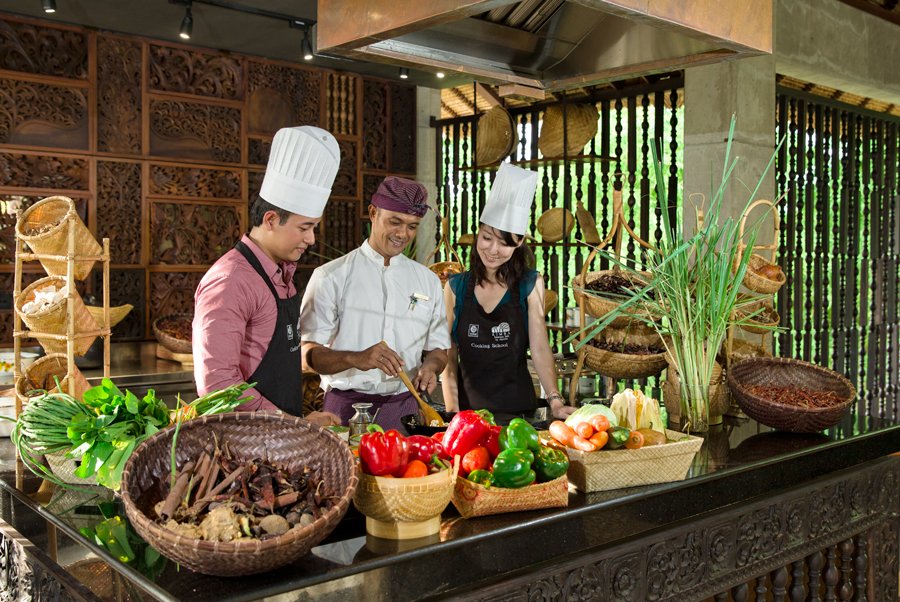
Is a Bali Cooking Class Worth It?
Is a Bali Cooking Class Worth It? For many travelers, the answer depends on what they want from their time on the island. If your idea of a Bali vacation is limited to beaches, temples, waterfalls, and sunset dinners, a cooking class may initially seem like an optional activity. But spending a few hours learning how local food is prepared can offer something that ordinary sightseeing cannot: direct participation in Balinese culture.
Instead of simply eating a plate of nasi campur or ordering satay at a restaurant, you get to understand what happens before the food reaches the table. You can handle local ingredients, learn traditional techniques, prepare several dishes, and eventually sit down to eat something you helped create.
For some travelers, that makes the experience one of the highlights of the entire trip.
Is a Bali Cooking Class Worth It for First-Time Visitors?
For first-time visitors, a cooking class can provide a different perspective on Bali.
Tourists often experience the island through attractions. They visit temples, photograph rice terraces, relax beside swimming pools, or explore beaches. These are all worthwhile, but they can sometimes leave you observing Bali rather than interacting with it.
Food offers a different opportunity.
A Bali cooking class introduces you to everyday ingredients and traditions that may otherwise remain invisible. You discover how spices are combined, why particular ingredients are used, and how food can be connected to family and community life.
The experience is also relatively easy to fit into a vacation schedule. Most classes take only part of a day, leaving plenty of time for other activities.
That combination of culture, entertainment, and practical learning is one of the strongest reasons to consider booking one.
You Learn More Than Recipes
One common misconception is that a cooking class is simply a demonstration followed by lunch.
A quality experience should offer considerably more.
You may learn how fresh turmeric differs from powdered turmeric, how to prepare lemongrass, how to recognize galangal, or how to balance the heat of fresh chilies.
The instructor may explain why certain spices are ground together and why a particular ingredient is added at a specific stage.
These small details are valuable because they help you understand the logic behind the cuisine.
Once you understand that logic, you can experiment at home rather than simply following a recipe mechanically.
That makes the knowledge more useful long after your Bali vacation ends.
The Cultural Side of the Experience
Food is closely connected with Balinese life.
Certain dishes can be associated with ceremonies, family gatherings, religious occasions, or everyday meals. Cooking methods and recipes can also vary between families and communities.
A local instructor can explain these connections in a way that a restaurant menu cannot.
You might discover that a dish you thought was simply a popular tourist food has a much deeper cultural background.
You may also learn why certain ingredients are considered essential in traditional cooking.
This cultural context can turn a simple meal into a much richer experience.
For travelers who enjoy understanding the places they visit rather than simply photographing them, this is a major advantage.
Is a Bali Cooking Class Worth It for Food Lovers?
For food lovers, the answer is often an easy yes.
Bali has an enormous variety of culinary Bali experiences, from small local food stalls to sophisticated restaurants. A cooking class allows you to move behind the finished dish and understand how the flavors are constructed.
You might work with chilies, shallots, garlic, ginger, turmeric, coconut, lemongrass, and other aromatic ingredients.
Some classes also introduce traditional spice mixtures that form the foundation of several dishes.
The most interesting part can be discovering how relatively simple ingredients create complex flavors when prepared correctly.
If you enjoy experimenting in the kitchen, you may find the class particularly rewarding because it gives you techniques that can be adapted to other recipes.
The Market Visit Can Add Real Value
Some cooking experiences begin with a visit to a traditional market.
This can significantly increase the value of the activity.
Instead of entering a kitchen where every ingredient has already been measured and prepared, you first see where the food comes from.
A local guide or instructor can introduce you to fresh produce, spices, herbs, seafood, meat, and other ingredients.
You can see what local shoppers purchase and observe the atmosphere of a working market.
Then, when you return to the kitchen, those ingredients have a purpose.
You understand where they came from and how they will become part of your meal.
If you have never visited an Indonesian market before, this can be almost as interesting as the cooking itself.
What About Travelers Who Cannot Cook?
You absolutely do not need to be a skilled cook.
In fact, beginners are often among the people who enjoy these experiences most.
A good instructor demonstrates each technique before asking participants to try it.
You may receive help with chopping, grinding, mixing, wrapping, or cooking.
Mistakes are normal.
Your spice paste may not have exactly the right texture the first time. Your banana-leaf wrapping may look different from the instructor’s. Your first attempt at shaping satay may be uneven.
That is part of learning.
The atmosphere is usually much more relaxed than a professional kitchen.
You are there to experience something new, not pass a culinary examination.
Hands-On Cooking Makes a Difference
There is a significant difference between watching a chef cook and actually preparing the food yourself.
A demonstration can teach you what a finished dish should look like.
Hands-on cooking teaches you how to get there.
You feel the texture of the ingredients.
You smell the spices as they are crushed.
You see how the color changes during cooking.
You learn when a mixture appears ready.
Those sensory details are difficult to understand from a written recipe.
For this reason, if you are deciding whether a cooking experience is worthwhile, look for one that allows substantial participation.
The more you do yourself, the more useful the experience is likely to be.
Is a Bali Cooking Class Worth It for Families?
A cooking class can be surprisingly enjoyable for families.
Children can participate in simple preparation tasks under supervision, while older children may enjoy learning more complicated techniques.
It is also an activity where parents and children can work together instead of simply moving from one attraction to another.
However, choose the class carefully.
A long, formal session may not be suitable for very young children.
Look for experiences that are relaxed, interactive, and family-friendly.
You should also consider the time of day. Younger children may be happier with a morning activity, while teenagers may prefer an afternoon or evening session.
A Good Option for Couples
Couples often look for activities that create shared experiences rather than simply checking another attraction off an itinerary.
Cooking together naturally provides that opportunity.
One person might prepare vegetables while the other works on spices. You can help each other shape satay or prepare a traditional dish.
At the end, you sit together and eat the food you created.
An evening Bali cooking class can be especially appealing for couples because the cooking experience can lead directly into dinner.
A morning session, meanwhile, can be combined with a market visit and leave the rest of the day available for exploring.
Morning or Evening?
The best time depends on your travel style.
Morning sessions can be ideal if you like early starts and want to experience a local market.
They also leave your afternoon free.
Evening sessions may be better if you prefer slow mornings or want to spend the daytime exploring Bali before finishing the day with cooking and dinner.
Neither time is automatically superior.
The quality of the instructor, menu, location, group size, and amount of hands-on participation usually matters more than the starting hour.
If you are comparing the two formats, our guide to Morning vs Evening Bali Cooking Class can help you decide which schedule fits your itinerary.
How Much Food Do You Actually Get?
Another practical consideration is the meal itself.
Most cooking classes prepare several dishes, although the exact number varies.
You might make a rice dish, vegetable preparation, satay, sambal, or another traditional specialty.
The combination can give you a better understanding of how a Balinese meal works.
Instead of eating one dish by itself, you experience contrasting flavors and textures together.
Some classes also provide additional food or drinks.
Before booking, check what is included so your expectations match the actual experience.
The purpose of the class is education as well as eating, but you should still finish feeling satisfied.
Is It Expensive Compared With Eating at a Restaurant?
A cooking class will usually cost more than simply buying a meal.
That comparison, however, is not entirely fair.
When you pay for a class, you are paying for more than food.
The price may include an instructor, ingredients, kitchen facilities, equipment, market transportation, a guided market visit, recipes, and several hours of entertainment.
You are also receiving an experience that you cannot get from ordering a dish.
If your primary goal is simply to eat cheaply, a cooking class may not be the best choice.
If you value experiences and learning, the additional cost can make sense.
What Skills Can You Take Home?
The long-term value of a cooking class is one of its strongest advantages.
After returning home, you can recreate some of the dishes you learned in Bali.
You may also start using techniques in other recipes.
For example, learning how to balance fresh chilies with acidity can improve your understanding of sauces and condiments generally.
Learning how to use a mortar and pestle can change how you prepare aromatic ingredients.
Understanding how coconut, herbs, and spices interact can also make you more confident when experimenting with Southeast Asian cuisine.
Your printed or digital recipes become a practical souvenir.
Unlike a traditional souvenir that sits on a shelf, culinary knowledge can be used repeatedly.
The Experience Is More Memorable Than a Typical Meal
Think about the meals you eat while traveling.
Some are delicious but quickly forgotten.
Others become memorable because of where you ate them, who you were with, or what happened during the experience.
A cooking class has several elements that can make it memorable.
You are learning something unfamiliar.
You are participating.
You are interacting with other people.
You are working with unusual ingredients.
Then you get to eat the result.
That sequence creates a story around the meal.
Years later, you may remember struggling to grind the spice paste or trying to wrap food in banana leaves just as clearly as you remember the taste.
What If You Have Dietary Restrictions?
Many cooking schools can accommodate dietary requirements when informed in advance.
Vegetarian and vegan menus are available at some classes, while others can adapt certain recipes.
However, you should never assume.
Contact the organizer before booking if you have allergies or strict dietary requirements.
Ask about ingredients such as seafood, peanuts, soy, eggs, dairy, or other foods that may be relevant to your diet.
A clear conversation beforehand can prevent problems during the class.
It also gives the instructor enough time to prepare suitable alternatives.
Is a Bali Cooking Class Worth It During a Short Bali Trip?
Even if you are only staying in Bali for a few days, a cooking class can be worthwhile.
Because most sessions take only part of a day, you do not necessarily need to sacrifice an entire day of sightseeing.
A morning experience can leave your afternoon open.
An evening experience can fit after a day at the beach or sightseeing.
If your schedule is extremely tight, however, prioritize the experiences that matter most to you.
The value of a cooking class depends partly on your personal interests.
If you love food and cultural experiences, it may be worth making room for.
If cooking does not interest you at all, your limited vacation time may be better spent elsewhere.
How to Choose a Quality Cooking Class
Rather than choosing based only on price, look at what the experience actually includes.
Consider these questions:
- Is the class genuinely hands-on?
- How many people are in the group?
- Is a market visit included?
- How many dishes will you prepare?
- Are ingredients included?
- Is transportation available?
- Are dietary requirements accommodated?
- How long does the experience last?
- Does the instructor explain the cultural background?
- Do you receive recipes afterward?
A class that answers most of these questions clearly is easier to evaluate.
Reviews can also help, particularly when previous participants mention the instructor’s teaching style and how much cooking they actually did.
The Instructor Matters More Than the Kitchen
A beautiful cooking venue is nice, but the instructor can have a much greater effect on the experience.
A knowledgeable instructor can explain unfamiliar ingredients, demonstrate techniques clearly, answer questions, and tell stories about Balinese food culture.
They can also adapt the pace when participants are struggling.
This is especially important for beginners.
A basic kitchen with an enthusiastic local instructor can provide a better experience than an impressive facility where participants spend most of their time watching.
When researching classes, pay attention to comments about the teaching itself.
You Do Not Have to Be a Food Expert
Some travelers hesitate because they do not know much about Indonesian cuisine.
That should not stop you.
A cooking class is precisely the place to ask questions.
You might learn the difference between several types of spices, discover why fresh ingredients are preferred, or finally understand what makes Balinese sambal different from other Indonesian sambals.
Curiosity is more important than prior knowledge.
The experience is designed to introduce you to something unfamiliar.
When It May Not Be Worth It
There are situations where a cooking class may not be the right activity.
If you dislike cooking, do not enjoy group activities, or have very little free time, you may prefer another Bali experience.
Similarly, if the class is mostly a demonstration and your main goal is hands-on learning, the experience may not meet your expectations.
This is why checking the format before booking matters.
The question is not simply whether cooking classes are worth the money.
It is whether this particular cooking class is worth the money for you.
A Different Way to Experience Bali
Bali offers countless activities, but food provides an especially personal connection with the destination.
You can visit a temple and admire its architecture.
You can walk through a rice field and appreciate the landscape.
But when you learn to prepare food with local ingredients, you participate in something that has a direct connection to everyday life.
That is what makes the experience different.
You are not simply observing Balinese culture.
For several hours, you become part of a small piece of it.
So, Is a Bali Cooking Class Worth It?
For travelers who enjoy food, culture, hands-on experiences, or learning something new, yes, it can be very worthwhile.
The strongest experiences combine practical cooking with cultural context. A market visit, local instructor, traditional ingredients, and a meal prepared by participants can turn an ordinary afternoon or evening into one of the more memorable parts of a Bali vacation.
It is not simply about learning how to prepare several dishes.
It is about discovering where the ingredients come from, understanding how flavors are developed, and gaining a new appreciation for the food you encounter throughout the island.
And perhaps the biggest advantage is that the experience does not end when the class finishes.
You can take the recipes, techniques, and memories home with you.
For travelers who want to understand what actually happens during the experience before booking, read Morning vs Evening Bali Cooking Class for a closer look at the typical cooking journey.