

What Marine Life Can You See with Bali Sea Walker?
If you are curious about exploring beneath Bali’s tropical waters without becoming a scuba diver, you may wonder, What Marine Life Can You See with Bali Sea Walker? The answer depends on the location, season, water visibility, and daily ocean conditions, but sea walker experiences can bring visitors surprisingly close to tropical fish and other underwater creatures.
Unlike observing the ocean from a boat or beach, a sea walker experience places you directly within the underwater environment. Participants normally walk along a designated seabed area while wearing a specialized helmet that provides an air supply. This gives you an unusual perspective: instead of looking down into the water, you are standing inside it.
Bali’s surrounding waters support diverse marine ecosystems, ranging from shallow coral communities to rocky coastal habitats. A short underwater walk cannot guarantee encounters with particular animals, but you may see colorful reef fish, sea stars, small crustaceans, coral formations, and other marine organisms.
The most important thing is to approach the experience with realistic expectations. Marine life is wild, and there is never a guarantee that a particular animal will appear exactly when you enter the water.
What Marine Life Can You See with Bali Sea Walker?
The marine life you encounter during a sea walker activity depends strongly on the specific site. Some areas are designed around shallow reef environments, while others may feature artificial structures or underwater attractions that attract fish.
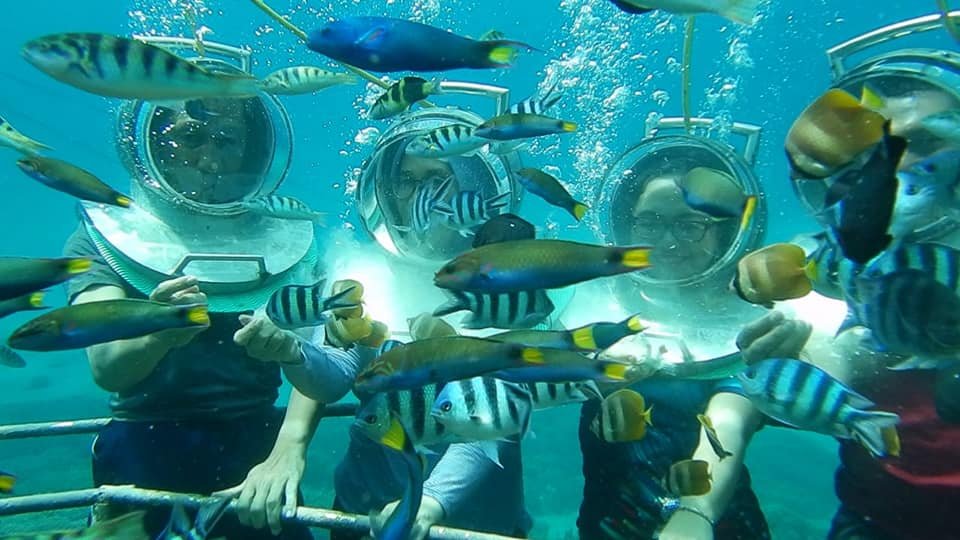
One of the most common sights is tropical reef fish.
Small schools may move around the underwater walking area, sometimes passing close to participants. Different species can appear in different locations, and their colors can range from silver and yellow to blue, black, orange, and combinations of several shades.
You may also notice fish hiding around rocks or coral structures. Some species stay close to the seabed, while others move continuously through the water column.
Because sea walking generally takes place in a relatively controlled area, you may spend more time observing individual fish than you would during a fast-moving boat excursion.
The experience is less about finding one famous animal and more about discovering the small details of a living underwater environment.
Colorful Reef Fish Around the Walking Area
Tropical reef fish are among the most memorable animals you may encounter.
Depending on the destination, you could see species such as butterflyfish, angelfish, damselfish, wrasses, parrotfish, surgeonfish, and other reef-associated species.
Their behavior can be just as interesting as their appearance.
Some fish travel in groups, creating flashes of movement as the school changes direction. Others remain close to coral or rocks and move away when something approaches.
Parrotfish, for example, are particularly interesting because of their distinctive shapes and colors. They are also important to reef ecosystems because their feeding behavior contributes to the production of reef-associated sand.
You should avoid trying to touch or chase fish.
Allowing animals to move naturally around you creates a better experience and reduces unnecessary disturbance.
Small Schools of Fish
One of the most exciting moments during a sea walker experience can happen when a group of fish suddenly surrounds the walking route.
A school can appear to move as a single organism.
Hundreds of small fish may change direction almost simultaneously, producing a shimmering effect as sunlight moves through the water.
You might see schooling fish moving around rocks, structures, or reef areas.
The exact species and number will vary considerably.
Visibility also matters. On a day with clear water, you may be able to see fish farther away. If visibility decreases because of weather, currents, sediment, or other conditions, the underwater scene can look completely different.
This is why two people visiting the same location on different days can have noticeably different experiences.
Coral and Reef Structures
Technically, coral is not marine life in the same sense as fish or turtles, but coral communities are an essential part of the underwater scenery.
Corals provide habitat for many smaller organisms.
When you look carefully, what initially appears to be a simple coral structure may contain tiny fish, crabs, shrimp, snails, and other creatures.
This is one reason sea walking can be especially interesting for people who enjoy photography and close observation.
Instead of simply looking for large animals, take time to examine the environment.
Look around the edges of rocks.
Watch movement between coral branches.
Notice tiny creatures hiding in small spaces.
The underwater world becomes much more interesting when you stop searching only for large, recognizable animals.
Sea Stars
Sea stars may sometimes be found in shallow coastal environments, although sightings are never guaranteed.
Their unusual shape makes them easy to recognize.
Depending on the species, they can have different colors and surface patterns.
If you see one during a Bali sea walker experience, observe it without touching or picking it up.
Sea stars are adapted to their underwater environment, and handling them can cause unnecessary stress or injury.
The best underwater wildlife encounter is one in which the animal continues behaving naturally while you observe it.
Crabs and Other Small Crustaceans
Small crustaceans can be much harder to notice than colorful fish.
Crabs may hide beneath rocks or around structures, especially during daylight hours.
Shrimp can be even more difficult to spot because some species are small and blend into their surroundings.
This is where having a guide can be useful.
A guide who knows the underwater area may notice creatures that inexperienced visitors would simply walk past.
Instead of looking only straight ahead, pay attention to the seabed and the spaces around rocks.
You may discover that the most interesting animals are not the largest ones.
Sea Urchins
Sea urchins can sometimes be found in rocky and reef environments.
They are recognizable by their rounded bodies and numerous spines.
Because those spines can be sharp, participants should follow the designated walking route and avoid touching the seabed unnecessarily.
This is another reason controlled movement matters during a sea walker activity.
The goal is to observe the underwater environment without disturbing it or accidentally injuring yourself.
Anemones and Their Tiny Residents
Sea anemones are fascinating because they often create miniature ecosystems.
Certain small fish and other organisms live closely associated with anemones.
The most famous example is the clownfish and its relationship with sea anemones. However, whether you see clownfish during your particular sea walker experience depends entirely on the location and conditions.
If you do encounter an anemone, look closely.
Its tentacles may be moving constantly with the water, creating a colorful and dynamic part of the reef.
Do not touch it.
Marine organisms can be surprisingly delicate even when they appear robust.
Turtles: Possible but Not Guaranteed
Sea turtles are among Bali’s most popular marine animals, so many travelers naturally ask whether they can see one while sea walking.
The answer is that it is possible in some areas, but it should never be considered guaranteed.
Turtles move through large areas and may not be present near a particular water adventures walking site when you visit.
Their presence can also depend on habitat, food availability, weather, and natural behavior.
If seeing turtles is one of your main goals, research the specific destination rather than booking a generic sea walker activity expecting a turtle encounter.
And if you do see one, give it plenty of space.
Never chase, touch, block, or attempt to ride a sea turtle.
Watching a wild turtle continue peacefully through the water is far more rewarding than forcing an interaction.
Can You See Nemo?
Many visitors use the name “Nemo” when talking about clownfish.
Clownfish are certainly among the most recognizable tropical reef fish, and they can be found in parts of Indonesia’s coral reef ecosystems.
However, there is an important difference between saying an animal exists in Bali and guaranteeing that you will see it during a particular activity.
The underwater site, habitat, season, visibility, and daily conditions all matter.
If you see a clownfish, resist the temptation to touch it or get too close.
Watch its behavior from a respectful distance.
You may notice it moving among the tentacles of an anemone, disappearing and reappearing as it searches for food or responds to movement nearby.
That small interaction can be more fascinating than a staged wildlife encounter.
What About Octopuses?
Octopuses are highly intelligent and adaptable marine animals, but they are masters of hiding.
They can change color and texture and squeeze into surprisingly small spaces.
Because of this, you should not expect to see one during every sea walker session.
If your guide points out an octopus, take your time observing it.
You may initially see only part of the animal before noticing its shape against the seabed.
An octopus may also disappear quickly if it feels threatened.
This is a good example of why wildlife encounters should never be forced.
Sometimes the most memorable sighting is the animal you almost missed.
Small Marine Creatures Are Worth Watching
A common mistake is concentrating exclusively on large animals.
Bali’s underwater environment contains countless small organisms.
You may notice tiny fish, snails, sea cucumbers, shrimp, crabs, worms, and other small creatures depending on the location.
Some have camouflage patterns that make them extremely difficult to spot.
Others are surprisingly colorful.
If you slow down and observe the seabed carefully, the experience becomes more like underwater wildlife watching than simply taking a walk.
This can be particularly enjoyable for photographers and travelers who like nature.
You do not need to see a giant turtle to have a memorable marine-life encounter.
Sometimes a tiny creature hiding in coral can be the most interesting discovery of the day.
Does the Time of Day Affect Marine Life?
Yes.
Marine animals have different daily patterns.
Some species are more active during daylight, while others become active after sunset.
Most standard sea walker activities operate during daylight hours, which means you are primarily observing daytime marine behavior.
Sunlight can also influence underwater visibility and the appearance of colors.
When sunlight reaches clear tropical water, fish and coral can appear dramatically brighter.
Cloudy weather can produce a softer underwater atmosphere.
Again, conditions vary.
Do not expect every visit to look identical.
Water Visibility Makes a Big Difference
Clear water can dramatically improve the experience.
When visibility is excellent, you can see farther and observe more of the surrounding environment.
Poor visibility can make the underwater area appear smaller and reduce the chance of spotting animals at a distance.
Several factors can affect visibility, including rainfall, waves, currents, sediment, plankton, and local conditions.
This means that marine-life sightings are partly a matter of timing.
Even a location known for abundant fish can look different after a period of rough weather.
Rather than judging the experience solely by the number of animals you see, appreciate the underwater environment as a whole.
Why You Should Never Feed Marine Life Without Permission
Feeding fish may seem like an easy way to attract them.
However, wildlife feeding can alter natural behavior and create ecological problems when it is not properly managed.
Some commercial activities may incorporate controlled feeding as part of their experience, but practices vary.
Participants should never bring their own food underwater or feed animals independently.
If an operator has an established wildlife-interaction program, follow its instructions exactly.
Otherwise, simply observe.
A natural encounter is always preferable to forcing animals to approach.
Protecting Bali’s Underwater Environment
Seeing marine life comes with a responsibility.
Coral reefs are fragile, and even seemingly harmless contact can cause damage.
During a sea walker activity, remain on the designated route.
Do not stand on coral.
Do not break pieces from the reef.
Do not collect shells, rocks, coral fragments, or other marine objects as souvenirs.
Do not chase fish.
Do not touch turtles, starfish, anemones, or other animals.
These simple habits allow future visitors to enjoy the same underwater environment.
Responsible tourism is not complicated.
In most cases, the best rule is simply to look without touching.
How to Get the Most From Your Marine Life Experience
You do not need specialist knowledge to appreciate underwater wildlife.
Before entering the water, learn a few basic things about Bali’s marine ecosystem.
During the activity, slow down.
Look in different directions.
Pay attention to the seabed, not just the open water.
Watch how fish behave rather than simply counting species.
If the guide points toward something, follow their direction carefully.
And do not spend the entire experience looking through your phone or camera.
Sometimes the best moments happen when you simply watch.
A school of fish passing around your helmet can last only a few seconds.
A turtle may appear and disappear quickly.
An octopus may camouflage itself before you realize what you are looking at.
Being present increases the chance that you will notice these moments.
What Marine Life Can You See with Bali Sea Walker? Setting Realistic Expectations
When asking What Marine Life Can You See with Bali Sea Walker?, it is important to understand that no responsible operator should promise a fixed list of animals.
You are entering a natural environment.
The most likely encounters will generally involve smaller tropical fish and other reef-associated organisms, but the exact experience changes with location and conditions.
You might see a colorful school of fish one day and fewer animals the next.
You might notice a sea star, crab, shrimp, or anemone that another visitor completely missed.
You could potentially encounter a larger animal, but it should be regarded as a fortunate wildlife sighting rather than an expected part of the package.
That uncertainty is actually part of the adventure.
The ocean does not operate on a schedule.
A Bali sea walker experience can provide an unusual opportunity to observe tropical marine life from within its environment.
You may encounter colorful reef fish, schools of small fish, coral communities, sea stars, crabs, shrimp, sea urchins, anemones, and other small organisms. In some locations, you may also have the possibility of seeing larger animals such as turtles or octopuses, but sightings can never be guaranteed.
The best approach is to arrive with curiosity rather than a checklist.
Look closely.
Listen to your guide.
Respect the animals.
Protect the reef.
And remember that every underwater encounter is shaped by nature.
For travelers who are still unsure whether their swimming ability could affect the experience, read Can Non Swimmers Enjoy Bali Sea Walker? before planning your underwater adventure.